
Walk into almost any boardroom conversation about AI and you will hear the same two words: productivity and cost. How many hours can we automate? How many transactions can we process without adding headcount? How lean can we get?
Those are reasonable questions. But when they become the only questions, they lead to what I believe are some of the most damaging decisions being made in business today, and most of them centre on one line item: labour.
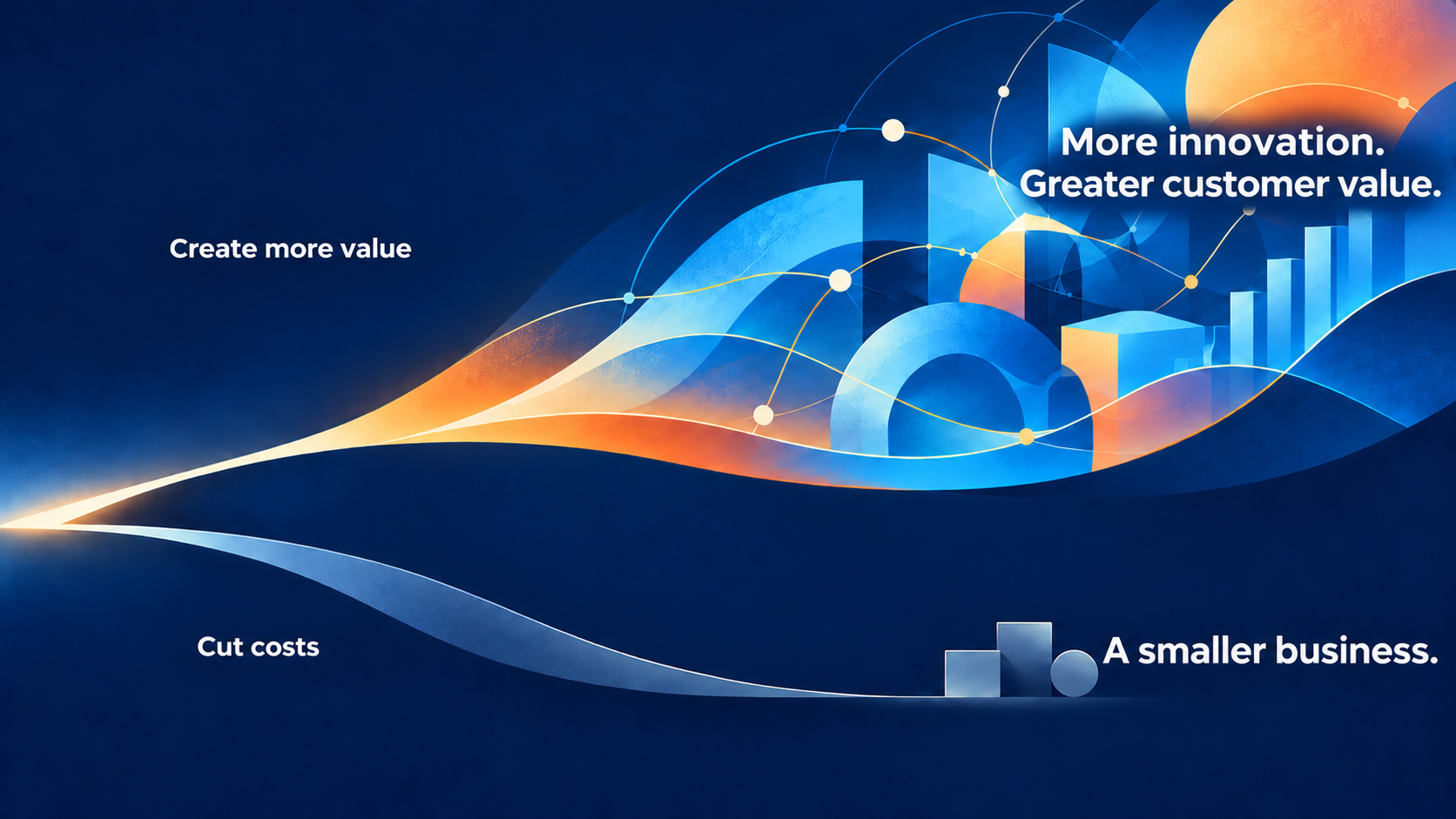
I have never believed AI is a cost-reduction tool. I believe it is a value-creation tool. And the difference between those two beliefs determines whether a company comes out of this decade stronger or simply smaller.
The efficiency trap
It’s easy to look at cost reduction as the outcome; it’s easy to measure and quickly shows up on a spreadsheet. You automate a process, reduce the size of the time, and report the savings. The board is happy for a quarter.
But look at what actually happens next.
You cut the people who knew how things really work. The employees doing “routine” work are often the ones who know which customer always needs a phone call, which supplier quietly bends the rules, and why the process has that strange extra step. That knowledge rarely lives in a system. When they leave, it leaves with them.
You win a race everyone else is running too. The same AI tools are available to your competitors. If your strategy is to use them to be cheaper, so is theirs. Efficiency gained through widely available technology is not a competitive advantage. It is table stakes, and the savings tend to get competed away.
You teach your people to hide opportunity. When employees learn that every process they help automate puts a colleague’s job at risk, they stop volunteering ideas. The people closest to the work, who are best placed to tell you where AI could help, have every reason to stay quiet.
You shrink the engine that creates growth. A company can only cut its way to so much profit. Eventually the question becomes “what’s next?”, and by then the people who could have answered it are gone.
A better question
If I am correct and AI is a value-creation tool, then leaders need to ask a different question.
The question senior executives usually put to their teams is: “Where can you become more efficient?” or “How can you control costs?”
The question they should be asking is:
“If you were freed from what you are doing now, what could you do to create more value?”
Asking this question shifts the focus away from the activity being performed and toward the value of the people who perform it.
The first question treats employees as a cost attached to a task. Remove the task, remove the cost. The second treats employees as a source of capability that is currently tied up in low-value work. Remove the task, release the capability.
It also changes the conversation inside the team. People who are asked how to cut costs become defensive. People who are asked what they would do with more time become creative. Most of them already have an answer. They have been carrying around a list of things they would do “if only I had the time”: the customer analysis nobody has done, the product improvement nobody has prioritized, the relationship nobody has had time to build.
The real opportunity in agentic AI
This matters even more as we move from AI tools that assist with tasks to agentic systems that can carry out entire workflows on their own.
The obvious use for agents is administrative work: processing invoices, scheduling, reconciling data, drafting routine reports. And yes, agents will do that work well.
But automating administration is not the strategic opportunity. The strategic opportunity is redeploying scarce talent towards creating differentiated value.
Every organization performs a set of core activities that differentiate its offering and provide unique value to its customers. Freeing people to continually improve these core capabilities and create new ones improves the organization’s competitive position and the value it creates.
Agentic Systems that allow this shift to happen, perhaps by removing the work that doesn’t create customer value, are where senior executives need to focus their attention. Drop the efficiency and cost angles.
It’s not about doing the same things as competitors more cheaply; it’s about freeing your employees to create new and better value for your customers.
Putting it into practice
For leaders who want to make this shift, a few practical starting points:
- Change the question in every AI conversation. Before approving any automation initiative, ask the team what they will do with the time it frees up, and make that part of the business case.
- Map your scarce talent. Identify the people and roles whose judgment and relationships are hardest to replace. Then find out how much of their week goes to work an agent could handle.
- Plan the redeployment before the automation. Decide where freed capacity will go before the system goes live. Capacity with no destination tends to get absorbed back into busywork or cut.
- Make it safe to volunteer ideas. Be explicit that the goal is to move people to higher-value work, not out of the business. You will get far better ideas when people are not afraid of the answer.
The choice in front of us
Every organization adopting AI is making a choice, whether it realizes it or not. It can use the technology to become a cheaper version of what it already is. Or it can use it to become something more valuable than it has ever been.
The first path is easier to measure. The second is the one that builds lasting advantage.
So the next time AI comes up in your leadership meeting, try replacing “Where can we cut?” with “What could our people create if we freed them?” The answers may surprise you, and they will almost certainly be worth more than the savings.