
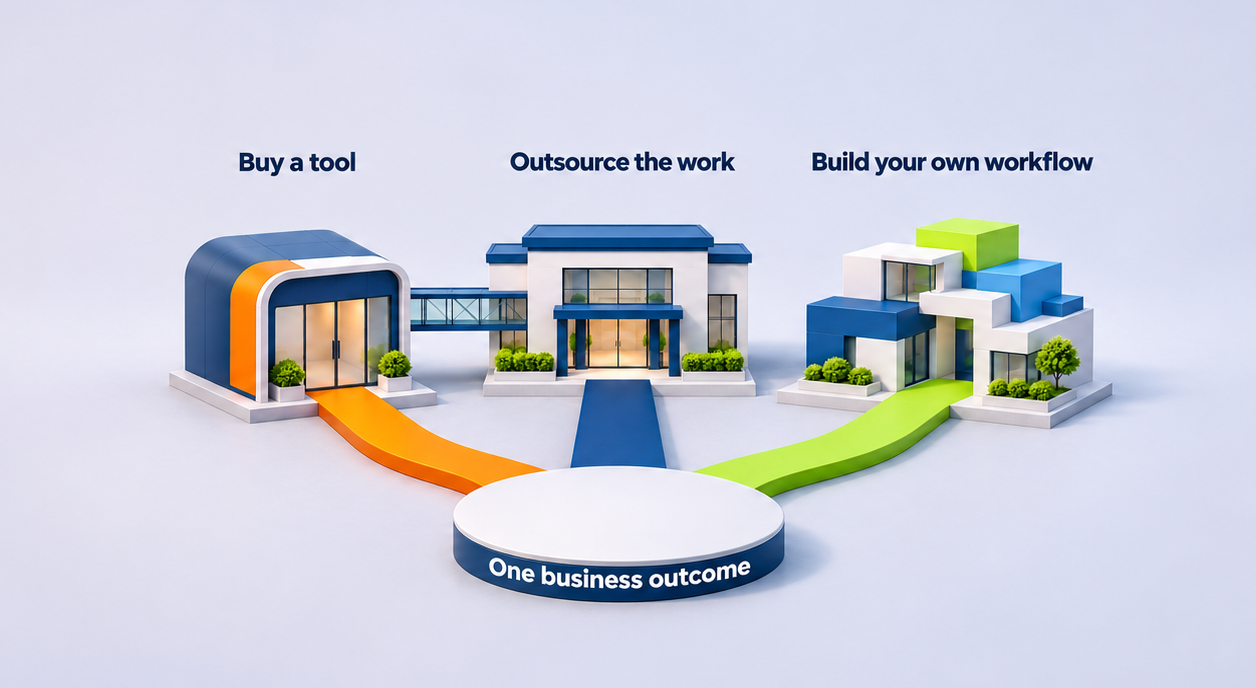
AI gives companies a new option between buying software and outsourcing a process: they can assemble and operate workflows that combine commercial AI tools with their own data and judgment. Leaders must carefully choose which work to buy, outsource or build, and more importantly, where to invest to create better customer value.
It is an age-old question: should we build a solution, or should we buy? Historically, the answer depended on whether the task was critical to differentiating your company and, if not, whether you could leverage economies of scale by outsourcing.
With AI, we wonder whether the economies are shifting to favour building bespoke solutions.
The AI everyone can buy
Off-the-shelf AI can make your company more efficient. It cannot make your company different. If a competitor can subscribe to the same tool tomorrow, that tool is table stakes, not an edge.
For a company under 100 people, this matters more than it does for a large enterprise. You don’t win on scale. You win on what you do that others don’t: your know-how, your customer relationships, the data you’ve built up over years. AI that strengthens those things is worth building to fit you.
All this leads to building bespoke AI for the work that sets you apart, and buying off-the-shelf AI for everything else. That’s how AI turns into a competitive position, not just a lower cost base.
But ready for a pivot? What if the economics of building an AI system mean you don’t have to buy an off-the-shelf solution? Instead, you “outsource” the work to an internal agentic team. This is a new path to consider.
Core vs. context: an old idea that fits AI well
Geoffrey Moore, author of Crossing the Chasm, divides a company’s work into two kinds. Core is the work that sets you apart and gives customers a reason to choose you. Context is everything your industry is simply expected to do. In his words, context is “table stakes,” while core is “how we win.”
Moore adds a second question: is the work mission-critical? Being core decides how much a piece of work can pay off. Being mission-critical decides how much damage it can do if it fails. His sourcing advice follows from that. Tasks that are both core and mission-critical, you do yourself. Context activities, you can outsource. Because your context work is an outsourcer’s core work.
Keep in mind that outsourced context activities are performed at an industry standard level. This is because, to scale, the outsourcing company typically treats the activity the same for all its customers. Now AI might be changing this, but that is a different discussion.
Moore recommended outsourcing Mission Critical – Context activities to a specialized company and keeping a careful eye on that work to ensure it is performed correctly. Certainly, in the age of AI, this remains true. However, the line is blurring a little as companies can maintain control of Mission Critical – Context work with agentic AI. In effect, “outsourcing” this work to an internal agentic team.
The priority for leaders is to identify the core and put a disproportionate share of discretionary resources into it, enough that competitors can’t easily catch up.
Moore developed this framework well before generative AI, and he doesn’t apply it to AI. But the fit is natural. Every AI investment you make lands on one side of this line or the other.
Shared AI tools are context by definition
Moore separates real differentiation from “neutralization”: catching up to what the market already expects. Productivity gains belong in the second group. They keep you in the game, but they don’t make you different. His advice for that kind of work is to “be absolutely ruthless with context” and simply optimize it.
Now look at the AI most small companies adopt first: a writing assistant, a generic support chatbot, the AI features built into their CRM. All useful, and all available to every competitor on the same terms. That makes them context.
Build-vs-buy guidance for AI draws the same line. If you use the same AI tool as your competitors, it’s table stakes. When the AI capability is what makes your offering different, building it gives you ownership and control. One example describes a lending firm whose loan-scoring model was trained on eight years of its own outcome data. The model is the product, and “the data is the moat.” (Fraction)
Another guide puts it as two questions: how strategically differentiating is the capability, and how much proprietary data do you bring to it? When both answers are high, that’s the strongest case for a custom build, because the data and the strategic value compound together. (NGen)
This is where smaller companies are stronger than they think. You may not have a big data team, but you do have proprietary know-how: years of client projects, quotes and win/loss history, service records, pricing decisions, and the judgment of your best people. No vendor can sell that to your competitors.
Building context AI solutions – still important
Even though shared AI tools are pure context, you can still gain value by building your agentic teams using these tools. This is the model of “outsourcing” the work to an internal agentic team.
CRM, company and contact research, and message-writing AIs are all examples of shared AI tools that cannot differentiate you, but used together, they form the backbone of your agentic outreach team.
When you fully outsource an activity, you get the scale and capability of that outsourcing company. You will have to monitor and control it, but the theory is that you gain from the overall relationship. But you also lose the learnings from that activity; those go to the outsourcer.
Building an internal agentic team to manage the context activity means you will have to build and maintain the agentic system, but you will have greater control and visibility while keeping the learnings from the activity.
Not all mission-critical context activities should be considered for an internal agentic team; some, perhaps even most, should go to an outsourcer. Nevertheless, you now have a new option that was not previously available. And an option worth exploring.
The biggest AI winners aim for growth, not just savings
McKinsey’s 2025 State of AI survey asked 1,993 respondents about their AI programs. Eighty percent said efficiency was a goal. But the companies getting the most value from AI often set growth or innovation as goals. (McKinsey, 2025)
Those growth-minded companies were more likely to report the benefits a CEO actually cares about: competitive differentiation, revenue growth, higher customer satisfaction, profitability and market share gains.
The 2026 edition found the same pattern. High performers pursue growth alongside efficiency, and they redesign workflows around AI rather than bolting AI onto the way they already work. (McKinsey, 2026)
A fair caveat: these are self-reported survey results. They show a link, not proof that growth goals cause better outcomes, and they don’t compare custom AI with off-the-shelf tools directly. But the direction is clear. The value shows up where AI changes how you compete, not only what you spend.
Bespoke doesn’t mean building from scratch
When people hear “bespoke AI,” they picture a lab training its own model. That’s not what this means. The common pattern is to buy frontier model APIs as commodity infrastructure, then build the application layer where your business logic and data create the difference. You rent the engine and build the car around your business. That’s within reach of a 40-person company.
It’s also getting cheaper. In McKinsey’s 2026 survey, nearly a third of organizations said they’d decided against buying at least one software product or feature because they could now build it in-house with AI coding tools. (McKinsey, 2026)
The counterpoint you should know about
MIT NANDA’s 2025 report on enterprise AI found that purchased AI tools succeeded 67% of the time, while internal builds succeeded far less often. That sounds like a point for off-the-shelf. Read closer, and it sharpens the argument instead:
- The biggest returns were in back-office cost cutting, like replacing outsourced processes and agency spend. That’s context work, exactly where buying makes sense.
- Generic tools stalled because they didn’t learn from or adapt to the company’s workflows.
- The successful buyers demanded process-specific customization and judged tools on business outcomes, not software benchmarks.
In other words, even the “buy” winners got something built around how they work. The lesson isn’t “never build.” It’s “don’t go it alone from scratch, and don’t build what you should buy.” (The MIT study’s methods have also been questioned, since it disclosed little about its sample.)
A playbook for the small-company CEO
- Name your core. Write down the two or three reasons customers choose you over the alternatives. If you can’t, start there.
- Sort every AI idea into core or context. Ask Moore’s two questions: does this create customer preference, and is it mission-critical?
- Buy for context, and be ruthless about it. One rule of thumb: if a vendor’s platform covers 80% or more of what you need out of the box, buy it. Email drafting, meeting notes, bookkeeping and basic support usually qualify.
- Build for core, on top of rented models. Put your proprietary data, your workflows and your expertise into a custom layer that competitors can’t subscribe to.
- Partner if you don’t have the team. Bespoke doesn’t have to mean in-house. Insist on customization to your process, and judge results on business outcomes.
- Redesign the work, don’t just add AI to it. The high performers in McKinsey’s data rebuilt workflows around AI.
- Measure growth, not just hours saved. Track win rates, retention, pricing power and share of wallet alongside efficiency.
Here’s how that split might look for a typical 60-person professional services firm:
| Scoping and pricing proposals from past project data | Core | Build |
| Delivery methods that encode your best people’s judgment | Core | Build |
| Client insight drawn from your engagement history | Core | Build |
| Meeting notes and email drafting | Context | Buy |
| Invoicing and expense processing | Context | Buy |
The bottom line
Off-the-shelf AI will make you as efficient as everyone else. Bespoke AI, aimed at the work customers choose you for, is how you pull ahead of them. Smaller companies can’t outspend their competitors on AI. They can out-focus them: buy the commodity, and put your AI budget behind your core.
Sources
- Geoffrey Moore, Core, Context and the Future of Work (LinkedIn)
- Moving from Context to Core, interview with Geoffrey Moore (IdeaConnection)
- Geoffrey Moore at Business of Software, transcript (The BLN)
- Build vs. Buy AI (Fraction)
- Custom AI vs. Off-the-Shelf AI (NGen)
- The State of AI 2025 (McKinsey)
- The State of AI 2026 (McKinsey)
- MIT report: 95% of generative AI pilots failing (Fortune, Aug 18, 2025)
- Why those AI pilots failed (Fortune, Aug 21, 2025)