
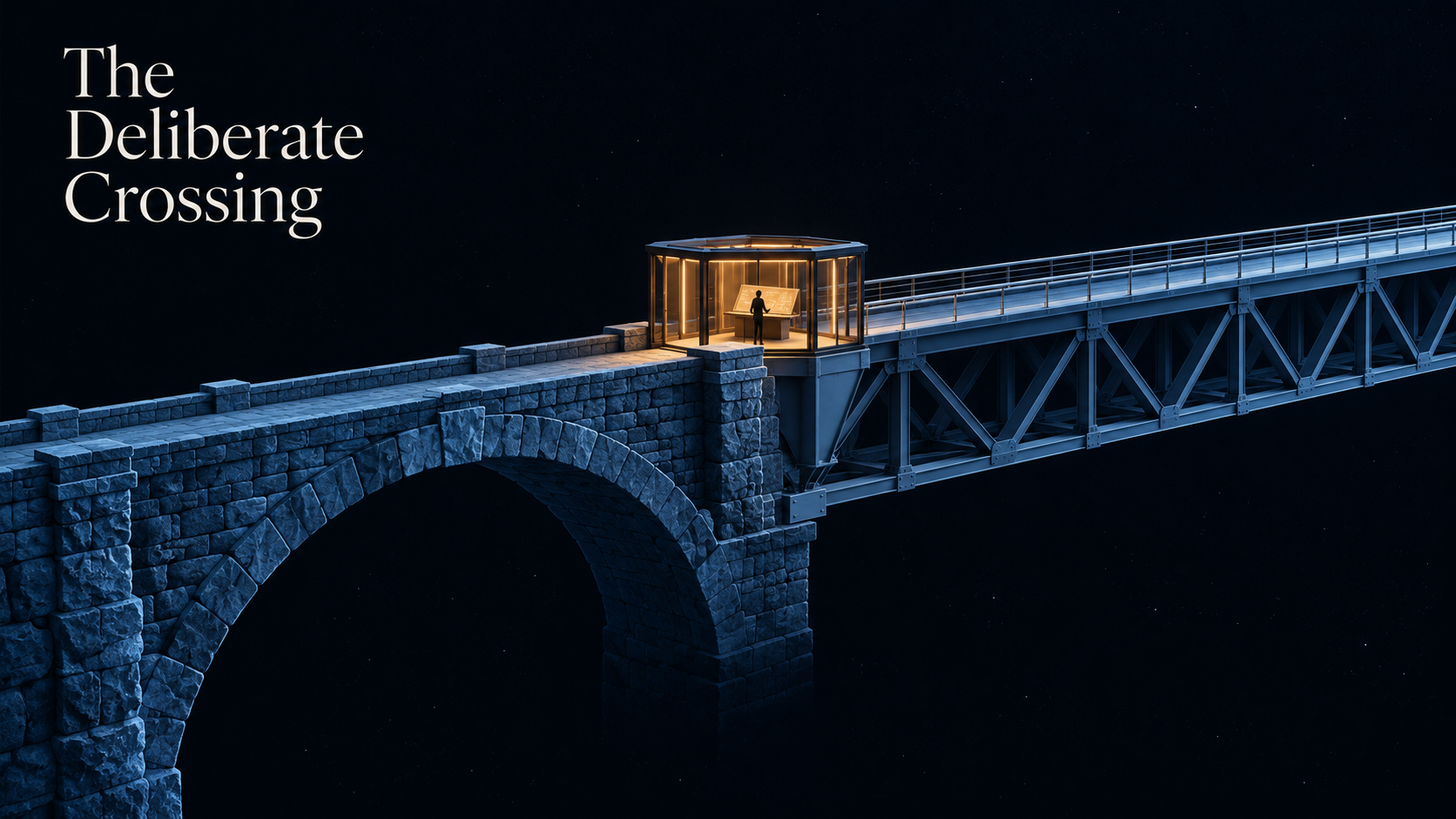
Short answer: Building a bespoke agentic AI solution is better when your organization needs distinctive workflows, strict operational controls, proprietary integrations, or a defensible capability. Buying is usually better for common use cases, rapid validation, and teams that cannot support ongoing AI engineering. For many enterprises, the strongest answer is neither extreme. It is a hybrid architecture that buys commodity capabilities while keeping critical orchestration, governance, and workflow logic under organizational control.
That distinction matters because agentic AI is not just another software feature. An agent can plan multiple steps, retrieve information, call tools, and execute actions. The build-versus-buy decision therefore affects more than functionality. It determines who controls the system, who carries the risk, and where long-term value accumulates.
When is a bespoke agentic AI solution better?
A bespoke solution makes sense when the workflow itself is strategically important and cannot be adequately represented by a standard product.
A custom agent can reflect an organization’s terminology, permissions, data structures, approval requirements, and decision boundaries. It can be restricted to specific tools, required to request human approval before sensitive actions, and prevented from operating outside defined conditions.
That level of alignment is valuable when an agent must:
- Coordinate several internal systems
- Apply organization-specific policies
- Work with sensitive or regulated data
- Operate in a specialized domain
- Follow complex approval and escalation paths
- Encode proprietary operational knowledge
The argument becomes stronger when the capability could create meaningful differentiation. Commercial tools often provide broad parity because competitors can buy the same service. A bespoke layer can incorporate proprietary data, workflow logic, and decision rules that are difficult to reproduce.
Still, custom does not automatically mean better. Poor data, weak evaluation, or careless system design can leave a bespoke agent less dependable than a mature commercial service.
What are the advantages of buying an AI service?
Buying offers speed.
Commercial services may already include model access, hosting, authentication, interfaces, monitoring, scaling, upgrades, and technical support. That removes a large amount of engineering work and allows an organization to test whether a proposed use case creates value before making a major architectural commitment.
Off-the-shelf services are often appropriate for relatively standard activities, including:
- Summarization
- Drafting
- Enterprise search
- Basic customer support
- Internal productivity assistance
- Early experimentation
They can also provide access to advanced models and infrastructure that would be expensive to reproduce internally.
This is not merely a budget consideration. Opportunity cost matters. Every specialist assigned to building model routing, observability, identity controls, and deployment infrastructure is unavailable for another technology priority. If a commercial product meets the actual requirement, rebuilding its commodity capabilities may be an expensive distraction.
Does bespoke agentic AI provide greater security and control?
Bespoke architecture provides greater control, but not necessarily greater security.
An organization can design custom requirements for data residency, retention, network isolation, access, model routing, auditability, and human oversight. This can be crucial in regulated or high-consequence environments.
But control creates responsibility. Agentic systems introduce risks such as prompt injection, sensitive-information disclosure, improper output handling, excessive agency, misinformation, supply-chain weaknesses, and unbounded consumption. If an agent can call tools and execute actions, an incorrect output may become an incorrect decision or unauthorized transaction.
A mature vendor may offer stronger baseline security than an inexperienced internal team can build quickly. Buying, however, creates reliance on that vendor’s security architecture, transparency, incident response, and contractual commitments.
The risk does not disappear. It moves.
NIST’s AI Risk Management Framework reinforces a broader principle: trustworthiness must be considered throughout the design, use, and evaluation of AI systems. Organizations retain responsibility for how a bought service is configured and used.
Which option has the lower total cost?
There is no universal answer.
The cost of buying includes more than subscription fees. Enterprises must consider usage charges, integrations, premium controls, data preparation, security reviews, training, customization, vendor oversight, and possible migration.
The cost of building extends well beyond initial development. It includes infrastructure, testing, data engineering, security controls, observability, specialist staff, upgrades, support, incident response, and compliance work.
Agentic workloads make the comparison harder. One user request can trigger several reasoning loops, retrieval operations, model calls, and tool invocations. Consumption may be less predictable than it is for a simple chatbot, so technical safeguards and financial limits are necessary in either architecture.
The right comparison is lifecycle cost against expected business value, not development budget against annual license price.
Why workflow redesign matters more than procurement
The best architecture can still fail inside a bad process.
McKinsey’s 2025 survey found that 88% of respondents reported regular AI use in at least one business function, yet only around one-third said their organizations had begun scaling AI programs across the enterprise. For agentic AI, 23% reported scaling an agentic system somewhere in the enterprise, while another 39% were experimenting.
More tellingly, high-performing organizations were nearly three times as likely to report fundamentally redesigning workflows. They were also more likely to establish leadership ownership, human validation, stronger infrastructure, and formal adoption practices.
Buying an agent and dropping it into an unchanged process is not transformation. Building a bespoke system that automates an inefficient workflow is not much better.
The decisive question is not simply whether to build or buy. It is where proprietary control creates enough value to justify ownership.
Is a hybrid agentic AI architecture the best choice?
For many enterprises, yes.
A hybrid design can use commercial foundation models or cloud infrastructure while retaining control of organization-specific orchestration, permissions, data access, evaluation, and user experience.
This approach avoids rebuilding commodity technology while concentrating custom investment where it matters. It may also improve portability if model interfaces, routing, and evaluation are designed so that providers can be changed.
Hybrid systems are not effortless. Multiple services, integration layers, and data flows can blur accountability. One team must still own the performance and governance of the complete system.
A practical build-or-buy test
Build a bespoke agentic AI solution when:
- The workflow is distinctive and strategically important
- Generic configuration cannot satisfy governance requirements
- Proprietary data and process knowledge can create differentiation
- The organization can fund long-term engineering and oversight
- Control over permissions, actions, and integrations is essential
Buy an AI service when:
- The use case is common or still unproven
- Speed to value outweighs deep customization
- Internal specialist capacity is limited
- A commercial product meets security and governance requirements
- The organization needs to validate demand before investing further
Choose a hybrid architecture when standard models are sufficient, but the workflow, controls, data access, or user experience should remain proprietary.
The answer depends on what deserves to be owned
It is not inherently better to build a bespoke agentic AI solution. It is better to build the parts that embody distinctive value, require exceptional control, or carry consequences a generic product cannot adequately manage.
Everything else is a candidate for purchase.
For enterprise leaders, the most disciplined strategy is often to buy the intelligence layer, build the organizational layer, and retain clear ownership of governance. The winning architecture is not the one with the most custom code. It is the one that gives the organization control where control matters, without turning commodity capability into a permanent engineering burden.
References: