
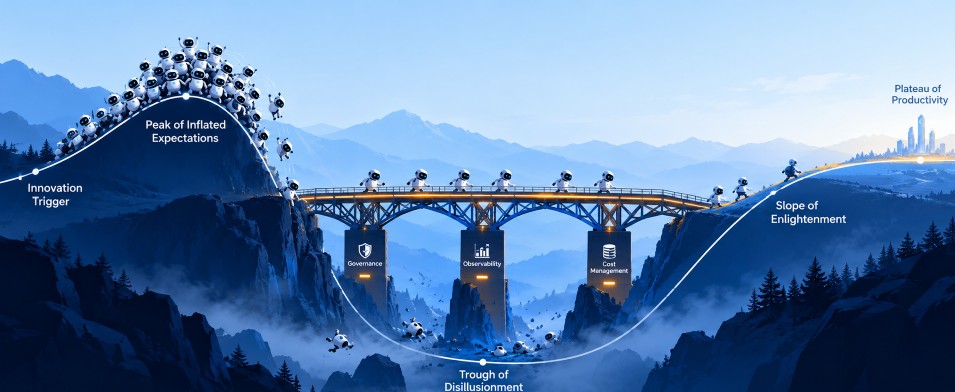
Gartner’s 2026 Hype Cycle for AI sends two messages that may appear contradictory.
Agentic AI is moving toward the center of enterprise technology. It also sits at the Peak of Inflated Expectations, where excitement can run ahead of operational readiness.
Both messages matter. Together, they validate a more disciplined position: multi-agentic systems are the next step in AI evolution, but deploying more agents is not the same as building a functioning execution system.
The winners will not be the companies with the most agents. They will be the companies that redesign work, establish control layers, and expand autonomy only when the evidence supports it.
TL;DR: What should business leaders take from Gartner’s Hype Cycle?
- Agentic AI is moving quickly toward mainstream enterprise adoption.
- Multi-agentic systems offer a practical way to divide complex work among narrowly scoped specialists.
- Gartner expects more than 40% of agentic AI projects to be canceled by the end of 2027 because of rising costs, unclear value, and inadequate risk controls.
- Governance, observability, identity, context, and cost management are not finishing touches. They are core infrastructure.
- Companies need to distinguish among agents, automation, and assistants instead of applying agents to every task.
- The real opportunity is workflow redesign, not simply giving employees more AI tools.
Why does Gartner’s Hype Cycle matter?
The Hype Cycle maps emerging technologies according to maturity, expected benefits, and time to mainstream adoption. Technologies move through five stages:
- Innovation Trigger
- Peak of Inflated Expectations
- Trough of Disillusionment
- Slope of Enlightenment
- Plateau of Productivity
In the 2026 cycle, Gartner places agentic AI at the Peak of Inflated Expectations. That placement is not a dismissal. It signals intense interest paired with immature practices, inflated assumptions, and an approaching test of real business value.
At the time of Gartner’s survey, 17% of organizations had deployed AI agents. More than 60% expected to deploy them within two years, representing the most aggressive adoption curve among the emerging technologies measured.
Gartner also forecasts that by 2028, 15% of day-to-day work decisions will be made autonomously, up from 0% in 2024. It expects 33% of enterprise software applications to include agentic AI, compared with less than 1% in 2024.
The direction is clear. AI is moving from answering questions and producing content toward taking actions, coordinating tasks, and participating directly in operating workflows.
That is precisely why multi-agentic systems matter.
Why are multi-agentic systems the next step?
A single general-purpose agent can appear impressive in a demonstration. Enterprise work is less forgiving.
Real workflows cross functions, systems, approval boundaries, and risk levels. A sales process may involve account research, qualification, messaging, scheduling, CRM updates, proposal development, pricing approval, and follow-up. Asking one agent to handle the entire process creates broad permissions, ambiguous accountability, and a large failure surface.
Multi-agentic systems take a different approach. They divide work among specialist agents with narrow roles, defined context, and explicit authority. Those agents can operate through several orchestration patterns:
- Sequential, where one agent completes a task before another begins
- Concurrent, where several agents work in parallel
- Handoff, where responsibility moves according to conditions or expertise
- Group chat, where multiple agents contribute to a shared decision or output
This resembles a well-designed operating team more than a single all-purpose tool. Each participant has a job. Handoffs are visible. Authority has limits. Human intervention occurs where judgment, relationships, risk, or accountability demand it.
The model is compelling because it reflects how complex work already gets done. But coordination also creates new requirements. Agents need shared context. They need reliable identity and permissions. Their actions need to be observed, evaluated, and audited.
The leap from one agent to multiple agents is not merely a change in quantity. It is a change in system design.
The winners will not deploy the most agents. They will build the most accountable execution systems.
Why will so many agentic AI projects fail?
Gartner predicts that more than 40% of agentic AI projects will be canceled by the end of 2027. The expected causes are escalating costs, unclear business value, and inadequate risk controls.
That warning deserves more attention than another polished demonstration.
Many early projects begin with a tool and search for a use case afterward. Teams prove that an agent can complete a task, then mistake technical possibility for an operating model. Questions about ownership, reliability, escalation, economics, and governance arrive late, often after the system has already touched live work.
The issue is not that agents lack capability. It is that capability alone does not create dependable business performance.
Gartner’s analysis points to three essential control areas:
| Control area | What it must answer | What happens without it |
|---|---|---|
| Governance | Is agent behavior aligned with organizational policies and authority? | Unapproved actions, inconsistent decisions, and unclear accountability |
| Observability | Can the organization see what agents did, why they did it, and where failures occurred? | Silent errors and plausible but incorrect outputs |
| Cost management | Is compute consumption controlled relative to business value? | Unpredictable economics and expensive experimentation |
These controls must be designed before broad deployment. Adding them later is harder because permissions, workflow assumptions, and technical dependencies have already spread.
A durable enterprise architecture needs three connected layers.
First, an identity and context layer gives agents the right information, role, and access boundaries. Second, an orchestration plane coordinates tasks, handoffs, retries, and human escalation. Third, a governance and audit plane records activity, applies policy, monitors performance, and supports accountability.
Build the foundation before the agents. Otherwise, the organization is scaling uncertainty.
Why are AI seats not the same as AI systems?
Most companies already have AI inside the business. Employees use assistants for research, drafting, analysis, meeting notes, and countless small tasks.
That can improve individual productivity. It does not necessarily change organizational throughput.
The common pattern is seats, not systems. People gain access to AI tools, but the underlying work remains fragmented. Employees still copy information between applications. Reviews happen through email. Handoffs depend on memory. Approval steps remain unclear. Nobody owns the process from beginning to end.
Dropping an agent into that environment can make a broken workflow move faster without making it better.
Gartner’s distinction among assistants, automation, and agents is useful here:
| Approach | Best suited to | Typical role |
|---|---|---|
| Assistant | Information retrieval and user-directed support | Helps a person perform a task |
| Automation | Stable, routine, rules-based workflows | Executes repeatable steps |
| Agent | Work that requires decisions within defined boundaries | Selects and performs actions toward an objective |
Not every task needs an agent. Sometimes conventional automation is faster, cheaper, and more reliable. Sometimes an assistant is enough. An agent earns its place when the work requires bounded decision-making and the resulting value can be measured through cost, quality, speed, or scale.
The right question is not where can we add an agent?
It is how should this work operate now that people, automation, assistants, and agents can each play a role?
That question leads to workflow redesign. It forces the business to define the outcome, remove unnecessary steps, assign decision rights, improve handoffs, and decide where human judgment remains essential.
What should companies build before deploying more agents?
A practical multi-agentic system starts with the business outcome and works backward.
1. Define the outcome and its owner
Choose an important result, not a vague innovation objective. Establish who owns that result and how performance will be judged.
2. Map the current workflow
Document where work begins, who touches it, what systems are involved, where delays occur, and which decisions carry risk. This often reveals that the constraint is not a lack of AI. It is poor process design.
3. Assign the right execution method
Use assistants for retrieval and support, automation for predictable steps, and agents for decisions within controlled boundaries. Keep people involved where relationships, exceptions, accountability, or material risk require judgment.
4. Establish controls early
Define identity, access, context, monitoring, audit requirements, cost thresholds, and escalation paths before agents enter production.
5. Expand autonomy with evidence
Start narrow. Measure reliability, cost, quality, and business impact. Give agents more authority only after production evidence shows that the system can support it.
This approach is less dramatic than launching a broad autonomous agent. It is also far more likely to survive the Trough of Disillusionment.
What does Gartner’s warning really validate?
Gartner’s Hype Cycle does not undermine the case for multi-agentic systems. It sharpens it.
The adoption curve and 2028 forecasts show that agentic AI is becoming part of enterprise operations. The projected cancellation rate shows that enthusiasm without architecture will destroy value. The emphasis on governance, observability, cost, and workflow redesign shows where serious implementation must begin.
Growing B2B companies cannot afford open-ended experiments that add complexity without improving outcomes. They need more execution capacity, better economics, and clear ownership. That means using agents where they create meaningful leverage, while keeping people accountable for the result.
Multi-agentic systems are the next step. But the system is the product of deliberate design: specialist roles, redesigned workflows, bounded authority, visible handoffs, active controls, and measurable business outcomes.
The future will not belong to companies that merely adopt agents. It will belong to companies that build the foundation on which agents can be trusted to work.
Frequently Asked Questions
What is a multi-agentic system?
A multi-agentic system coordinates several specialist AI agents to complete parts of a broader workflow. Each agent has a defined role, context, and level of authority, with orchestration and governance connecting their work.
Are multi-agentic systems fully autonomous?
They do not need to be. Autonomy should vary according to risk, evidence, and business need. Humans should remain involved where judgment, relationships, exceptions, or accountability matter.
Why not use one generalist AI agent?
A generalist agent can be useful for broad assistance, but complex enterprise workflows benefit from narrower roles and permissions. Specialist agents make responsibilities, controls, and failures easier to isolate.
What should a company implement first?
Start with a valuable business outcome and redesign the workflow. Then establish identity, context, orchestration, governance, observability, and cost controls before expanding agent autonomy.
How should success be measured?
Evaluate the system through business measures such as cost, quality, speed, and scale. Technical completion alone does not prove business value.