
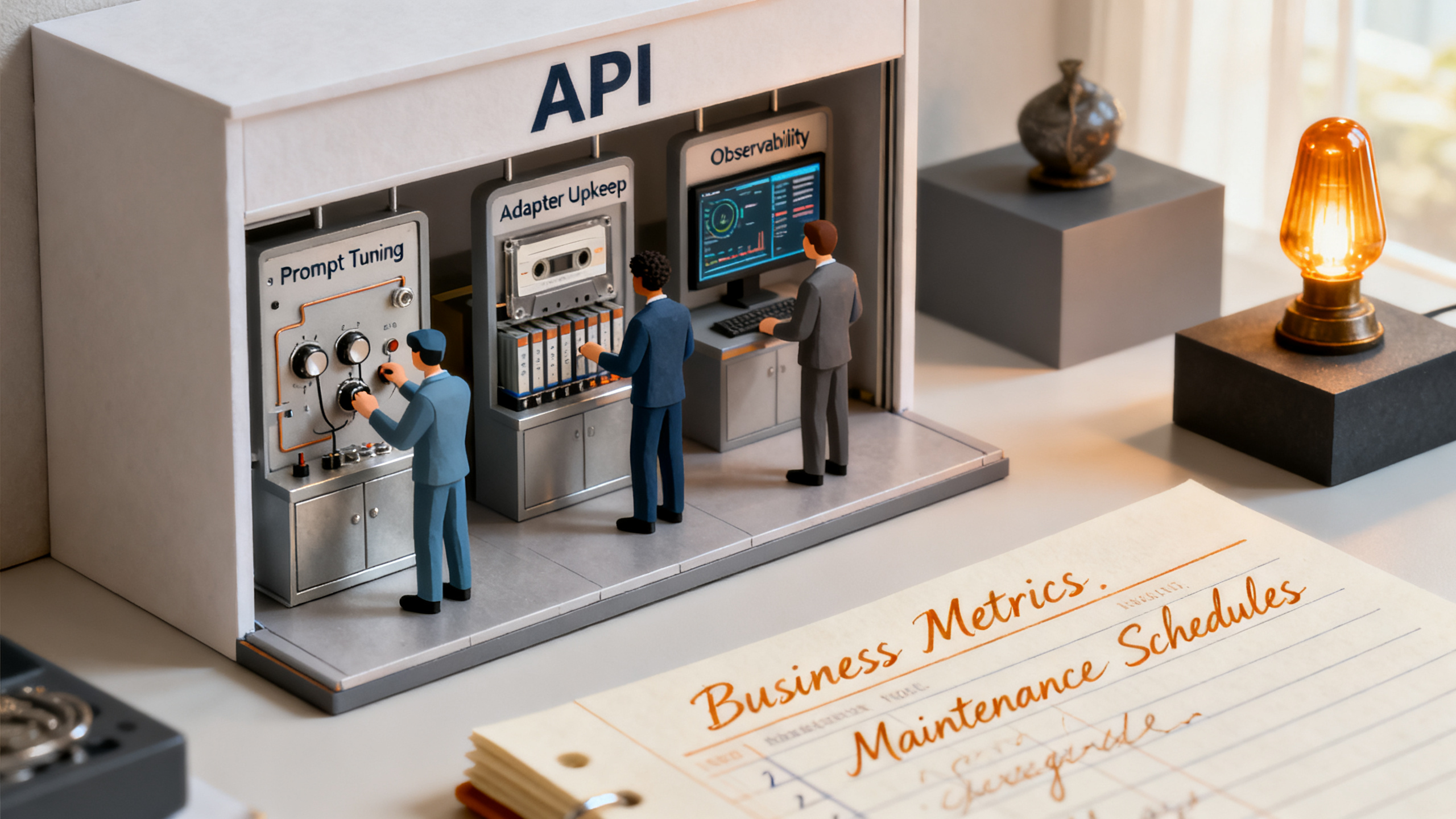
AI model portability costs are easy to underestimate because portability is often framed as an API problem. Put a common interface between the application and the provider, the thinking goes, and switching models becomes a configuration change.
Sometimes the code change really is that small. The migration is not.
Prompts behave differently. Tool calls drift. Structured outputs become less reliable. Safety policies change. Latency moves. Evaluation, revalidation, infrastructure, and operational ownership remain. An abstraction layer can reduce migration friction, but it also creates a permanent maintenance obligation.
The useful question is not whether portability is good. It is whether the option to switch is worth what you will pay to preserve it.
TL;DR: What should leaders know about AI model portability costs?
AI model portability costs include the ongoing expense of abstraction, testing, observability, compatibility maintenance, and support for provider-specific exceptions. Portability is usually worth funding selectively, especially for high-volume, long-lived, regulated, or strategically important workloads.
Key takeaways:
- API compatibility reduces code changes, not behavioral migration.
- Prompts are model-dependent behavioral programs, not portable configuration files.
- Abstraction converts some future switching effort into present and recurring platform work.
- High-volume workloads have more to gain because inference-cost differences compound.
- Provider-native features can make generalized abstractions actively limiting.
- Evaluation, observability, versioning, and rollback determine whether a switch is safe.
- A stable internal contract with replaceable provider adapters is usually more practical than one universal interface.
- The economic test is straightforward: expected avoided switching impact must exceed the carrying cost of portability.
What does AI model portability actually mean?
AI model portability is the ability to move an AI workload between models, providers, runtimes, or infrastructure targets without unacceptable cost, delay, or behavioral degradation. It covers far more than whether two providers accept similar request payloads.
Portability spans several layers:
- API portability: Can the application send and receive compatible requests?
- Prompt portability: Do instructions produce comparable results?
- Behavioral portability: Does the replacement preserve quality, format, tool use, safety, and reliability?
- Data portability: Can memory, cached context, retrieval assets, and state move safely?
- Infrastructure portability: Can serving, deployment, scaling, and monitoring operate on another target?
- Governance portability: Can audit, security, sovereignty, and compliance controls survive the change?
- Operational portability: Can teams support, observe, roll back, and troubleshoot the replacement?
A shared API addresses the first layer. Production migrations tend to expose the other six.
This distinction becomes sharper in agentic systems. Workflow state, routing logic, tool protocols, intermediate outputs, memory stores, and retry behavior may all contain model-specific assumptions. A provider adapter can translate syntax, but it cannot automatically preserve the meaning of every decision made by the model.
Where do AI model portability costs come from?
AI model portability costs arise across the full application stack, from adapter maintenance to behavioral testing and operational support. The abstraction itself is only one line item.
| Cost area | What teams must maintain | Why it persists |
|---|---|---|
| Provider adapters | Authentication, request formats, streaming, parameters | Providers change APIs and capabilities |
| Behavioral testing | Evaluation sets, regression tests, safety tests | Compatible inputs do not guarantee equivalent outputs |
| Prompt calibration | Instructions, examples, delimiters, schemas | Models interpret the same prompt differently |
| Operations | Routing, retries, quotas, fallbacks, incidents | More targets create more failure paths |
| Observability | Cost, latency, quality, drift, tool success | Safe switching requires measurable behavior |
| Infrastructure | Deployment artifacts, runtimes, scaling, GPUs | Alternative targets have different operating needs |
| Governance | Documentation, provenance, audit controls | Every qualified configuration must remain traceable |
| Opportunity cost | Reduced use of provider-specific features | A common interface can constrain differentiation |
There is also a less visible cost: organizational discipline. Application teams must use the abstraction consistently, document exceptions, preserve reproducible environments, and resist bypassing shared controls when a deadline gets uncomfortable.
That last part happens more often than architecture diagrams admit.
Why does API compatibility fail to make models interchangeable?
API compatibility means two systems can accept similar requests and return structurally compatible responses. It does not mean they will interpret instructions, choose tools, manage context, or produce evidence in equivalent ways.
Two models behind the same interface can differ in:
- Instruction following
- Prompt sensitivity
- Context allocation and truncation
- Tool selection and argument formation
- JSON and schema reliability
- Refusal and safety behavior
- Hallucination patterns
- Domain and multilingual performance
- Concision, verbosity, and tone
- Latency and token consumption
- Sampling and decoding defaults
This is the fault line in most portability strategies. The application successfully calls the replacement model, receives a response, and appears healthy. Yet required fields begin disappearing, tools receive malformed arguments, unsupported claims become more confident, or downstream parsers fail only on certain inputs.
The endpoint works. The product does not behave the same.
Portability can preserve the shape of a request while losing the behavior the application was built to trust.
Why are prompts the real switching cost?
Prompts are model-dependent behavioral programs that combine task instructions, output rules, examples, evidence requirements, tone, tool guidance, and error handling. Copying prompt text preserves the words, but not necessarily the behavior those words induced.
A prompt tuned for one model may underperform on another because each model has different instruction-following conventions, training influences, context behavior, tool semantics, safety policies, and output tendencies.
One model may treat a requirement as mandatory. Another may read it as a preference. One may infer a formatting pattern from two examples. Another may imitate those examples too literally. One may reliably produce constrained JSON. Another may add a helpful preamble that immediately breaks the parser.
Migration therefore becomes calibration rather than copying.
How should teams calibrate prompts during migration?
Teams should define the required destination behavior, measure drift on the target model, and then adjust the smallest effective layer. The goal is not to make the new model imitate every habit of the old one.
A practical sequence is:
- Define the destination contract.
- Run the existing prompt unchanged on the target.
- Measure behavioral drift.
- Classify failures by type and severity.
- Retune prompts, examples, parameters, or validators.
- Rerun affected regression tests.
- Revalidate dependent tools and workflows.
- Test held-out workloads.
- Shadow or canary the target model.
- Record the qualified prompt, model, parameters, and dependencies.
The destination contract should separate hard requirements from soft preferences. Schema validity, tool-call correctness, safety thresholds, and required evidence may be hard requirements. Tone, sentence length, and stylistic similarity may be negotiable.
Without that distinction, teams can spend weeks polishing surface resemblance while missing operational breakage.
What do real AI model migrations reveal?
Real migrations show that abstractions can reduce application-code edits while leaving behavioral, evaluation, infrastructure, and operational work intact. The strongest examples separate integration portability from production readiness.
What happened when Tursio moved between GPT models?
Tursio, an enterprise-search application, found that prompts performing perfectly on one GPT model degraded when used unchanged with newer models. The API path remained familiar, but model-specific behavior affected strict SQL interpretation and parsable output.
Tursio translated natural-language questions into structured operator trees involving filtering, grouping, ordering, joins, and aggregation. Each query used approximately three large language model calls, with an estimated 6,000 input tokens and 1,000 output tokens. The application ran across more than 100 instances and processed thousands of queries daily.
Failures included incorrect or missing ordering and grouping operations, wrong column names, omitted implicit filters, semantic errors, and parser-breaking output.
The team expanded short prompts into more explicit specifications covering output format, punctuation, naming conventions, implicit columns, exact values, empty-output behavior, and detailed examples. The revised prompts grew from a few lines to roughly a page and restored performance to 100%.
The first end-to-end migration took a couple of months. After Tursio created a representative testbed and repeatable prompt-migration process, subsequent migration work fell to a couple of weeks.
The abstraction helped. The evaluation system made it useful.
What did CIEL learn from moving to sovereign infrastructure?
CIEL, a document-intelligence pipeline, moved from a commercial API to an open-weight model hosted on sovereign infrastructure without changing application code. An OpenAI-compatible HTTPS endpoint preserved the integration, but substantial migration work remained.
The project still required:
- Evaluation of 16 candidate models
- A curated set of 91 documents, including 54 French and 37 German documents
- Approximately 1.8 million input tokens
- Approximately 40,000 manually validated output-field checks
- Prompt and output-schema experiments
- Tool-calling and constrained-JSON comparisons
- Chunking and fine-tuning experiments
- GPU and VRAM planning
- vLLM configuration
- Accuracy, latency, and token-use measurement
- Operational ownership of serving infrastructure and model versions
CIEL achieved integration portability. It did not receive behavioral or operational portability for free.
More importantly, the case shows where value really accumulates. The reusable asset was not merely the compatible endpoint. It was the ability to evaluate candidate models against a demanding, representative workload.
Do abstraction layers make migrations proactive?
Abstraction layers reduce code patch size, but they do not necessarily make organizations switch earlier or more safely. Ecosystem evidence shows that teams often remain reactive even when some portability machinery already exists.
A large-scale study of open-source applications found:
- 82% of migrations away from retired models occurred after shutdown.
- The median migration landed 39 days after shutdown.
- Only 8% of migrations switched providers.
- Existing abstraction layers reduced median patch size.
- Those layers did not eliminate behavioral and operational risk.
This matters because small code changes can create a comforting but misleading story. A one-line model identifier change may hide weeks of qualification work, or worse, encourage teams to ship without it.
Which workloads benefit most from model portability?
High-volume, long-lived, regulated, edge, and customer-critical workloads generally benefit most because switching impact or recurring operating cost is substantial. Short-lived experiments and workloads dependent on unique provider features usually benefit less.
| Workload type | Typical portability value | Primary reason |
|---|---|---|
| High-volume classification or extraction | High | Small unit-cost differences compound |
| Customer-facing generation | Medium to high | Outages and quality changes affect users directly |
| Internal low-volume copilots | Low to medium | Switching impact may remain limited |
| Regulated decision support | High, but expensive | Control matters, while revalidation raises costs |
| Agentic workflows using native tools | Medium or low | Tools, state, and orchestration are tightly coupled |
| Short-lived experiments | Low | The workload may end before the investment pays back |
| Edge or offline workloads | High | Runtime and hardware flexibility support continuity |
| Unique-capability workloads | Low | Abstraction may remove the feature creating value |
High-volume workloads deserve particular attention. When thousands or millions of calls accumulate, modest differences in token use, latency, or unit price can materially affect operating expense. Portability creates negotiating leverage and makes routing or alternative deployment more credible.
Still, volume alone is not enough. If only one model meets the quality threshold, theoretical portability has little practical value.
What is the lowest-cost architecture for AI portability?
The lowest-cost practical design is usually a stable internal contract connected to replaceable provider adapters. This protects the application boundary without forcing every provider into a lowest-common-denominator feature set.
What belongs in the stable internal contract?
The internal contract should define business behavior and measurable requirements that remain stable across providers. It should not expose every vendor parameter to application code.
Include:
- Business task definition
- Versioned input and output schemas
- Error taxonomy
- Timeout and retry policy
- Quality and safety thresholds
- Cost and latency budgets
- Evaluation datasets
- Audit and provenance fields
What belongs in provider-specific adapters?
Adapters should contain implementation details that naturally vary between models and providers. Keeping those differences explicit is often cleaner than pretending they do not exist.
Include:
- Authentication
- Request formatting
- Prompt and message serialization
- Tool-calling implementation
- Structured-output mechanisms
- Streaming behavior
- Rate-limit handling
- Model-specific parameters
- Provider safety and content-policy handling
This approach preserves portability where it matters while allowing provider-specific optimization. It also makes exceptions visible, testable, and removable.
A universal abstraction often looks elegant at the start. Over time, unique features arrive, teams request escape hatches, and the clean interface grows a collection of flags whose names quietly translate to which provider are we really using?
Better to acknowledge the boundary.
What capabilities make a model switch safe?
A model switch is safe only when the organization can prove that the replacement meets explicit workload requirements. Evaluation, observability, reproducibility, staged deployment, and rollback are therefore part of portability, not optional extras.
A minimum portability control set includes:
- A representative, versioned evaluation dataset
- Golden inputs and expected output properties
- Quality, safety, latency, and cost metrics
- Schema and tool-call validation
- Shadow or replay testing
- A/B or canary deployment
- Prompt and configuration versioning
- Model and dependency provenance
- Drift and failure-pattern monitoring
- Fast rollback
- Explicit handling of nondeterministic outputs
An abstraction without these controls creates false confidence. It tells teams that a replacement can be connected, not that it can be trusted.
Should every AI workload be portable?
No. Universal portability mandates can impose recurring cost, slow product development, and block valuable provider-specific capabilities even when a switch is unlikely.
The better policy is selective portability at stable architectural boundaries. Classify each workload, estimate switching probability and impact, identify nonfinancial requirements, and fund the option where the economics or risk justify it.
A useful decision checklist asks:
- Are multiple models genuinely capable of meeting the workload threshold?
- Is the workload expected to operate long enough to recover the investment?
- Could volume make price differences material?
- Would an outage, retirement, or policy change create serious business impact?
- Are sovereignty, resilience, or regulatory requirements likely to force migration?
- Can the team maintain representative evaluations?
- Does the workload depend on provider-native tools or behavior?
- Would a common interface weaken the product?
- Does the organization have capacity for parallel validation and staged rollout?
If most answers point toward low switching probability and low impact, build a clean boundary and stop there. If the workload is strategic, expensive, exposed, and replaceable, invest further.
Portability is an option. Options have value, but they also have carrying costs.
FAQ: What else should teams know about AI model portability costs?
Is switching AI models just an endpoint change?
Sometimes the application-code change is only an endpoint or configuration update. Production migration still requires testing prompts, behavior, schemas, tools, latency, safety, and dependent workflows.
Do OpenAI-compatible APIs eliminate migration work?
No. They can eliminate SDK or request-format rewrites, but they do not guarantee equivalent quality, tool behavior, structured output, context handling, or operational performance.
Why do prompts need retuning after a model switch?
Prompts interact with each model’s instruction-following conventions, context management, training, safety rules, and output tendencies. The same text can therefore induce different behavior on different models.
What is the biggest hidden portability cost?
Behavioral revalidation is often the largest hidden cost. Teams must prove that the replacement still meets workload-specific quality, safety, schema, tool-use, latency, and cost requirements.
When is portability most valuable?
Portability is most valuable for high-volume, long-lived, regulated, sovereignty-sensitive, customer-critical, or edge workloads with credible model substitutes. These workloads face either high switching impact or meaningful recurring cost exposure.
Can an abstraction layer hurt model performance?
Yes. A lowest-common-denominator interface can prevent teams from using provider-specific capabilities that improve quality, latency, cost, structured output, or tool integration.
What should companies build first?
Start with a stable internal contract, provider-specific adapters, versioned evaluations, configuration tracking, observability, and rollback. Add multi-provider routing or broader abstractions only when the workload economics justify them.
The real cost is not switching. It is preserving the right to switch.
AI model portability is not free, and it is not binary. Every adapter, regression suite, deployment target, and governance control carries a cost long before the organization changes providers.
That does not make portability wasteful. It makes it an investment decision.
The strongest approach protects stable business contracts, leaves room for provider-specific optimization, and builds the evaluation machinery needed to qualify a replacement. It spends heavily where switching is credible and consequential, then stays deliberately light elsewhere.
A portable API can change where a request goes. Only disciplined engineering can preserve what the application does when it gets there.