
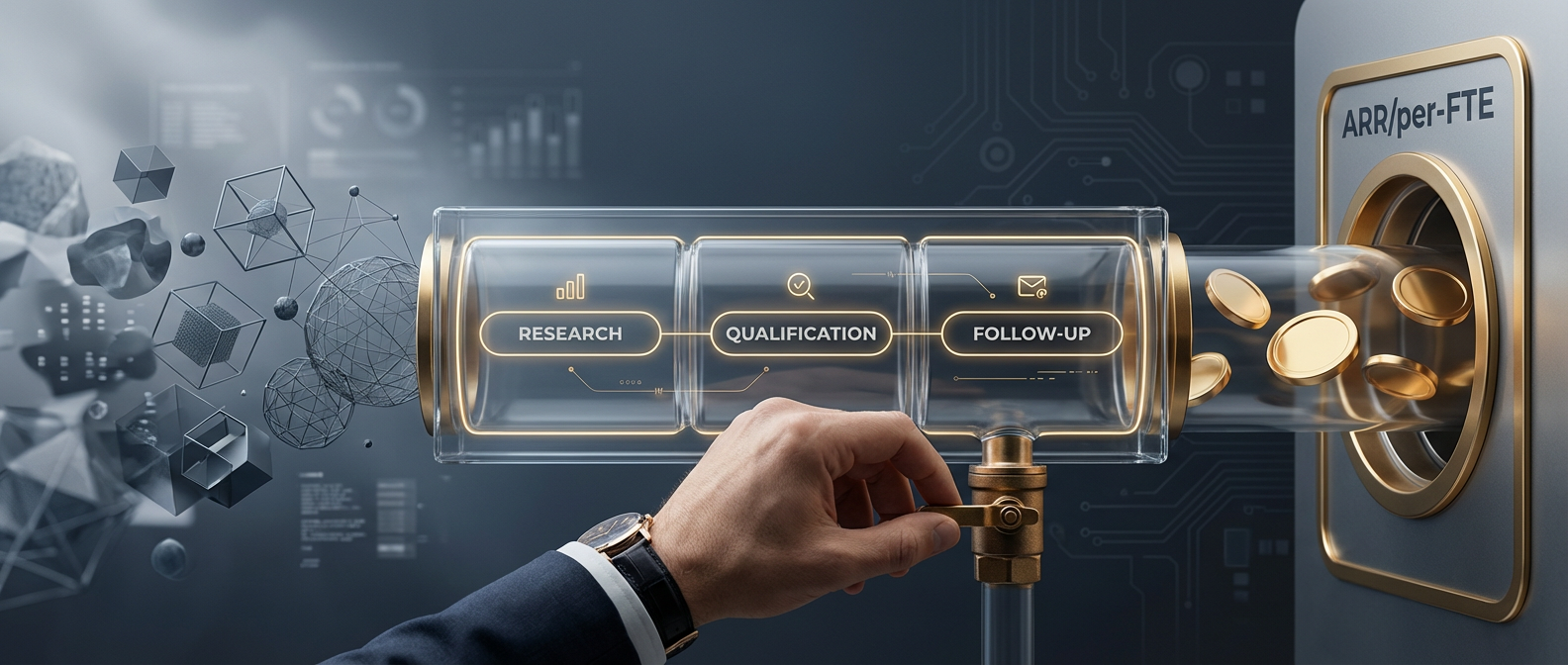
For the modern CEO, the era of growth at any cost has been replaced by a much more disciplined mandate: unit economics. While top-line revenue remains the ultimate scoreboard, the efficiency of the engine producing that revenue determines the long-term valuation and survival of the enterprise. At the heart of this engine sits Customer Acquisition Cost (CAC).
In the current B2B and SaaS landscape, CAC is no longer just a marketing expense to be managed; it is a strategic indicator of operational health. Benchmarking data from OpenView and SaaS Capital suggests that metrics like CAC payback periods and ARR-per-FTE are the North Stars for judging go-to-market (GTM) efficiency. When markets slow, the companies that thrive are those that can shorten the time it takes to recoup the cost of a new customer.
However, traditional methods of reducing CAC have hit a ceiling. You can only optimize ad spend or refine sales scripts so much before you encounter the fundamental bottleneck: human labor. Sales development reps (SDRs) and account executives (AEs) spend an inordinate amount of time on “shallow work” like manual prospect research, data entry, and basic follow-up. This is where Agentic AI enters the frame, not as a simple chatbot, but as a goal-oriented architectural shift that fundamentally alters the cost structure of acquisition.
The Shift from Generative to Agentic
To understand the impact on CAC, we must distinguish between standard generative AI and Agentic AI. While generative tools might help a rep draft an email faster, Agentic AI systems are designed with multi-step reasoning, memory, and the ability to use tools autonomously. According to research published in MDPI, these systems utilize planners and reflection loops to persist through complex tasks.
For a CEO, this means the AI doesn’t just “suggest” a task; it executes a workflow. It can synthesize public filings, monitor account signals, and run qualification dialogs without constant human intervention. By moving from human-led research to agent-led intelligence, you are effectively decoupling your pipeline growth from your headcount growth.
High-Fidelity Qualification and the End of Wasted Effort
One of the most significant drains on CAC is the “unqualified demo.” Every time a high-priced AE spends an hour on a call with a prospect who was never a fit, your blended CAC rises. Agentic AI attacks this waste at the source by performing deep-work research that was previously too expensive to do at scale.
These agents can combine CRM data with web searches and call transcripts to surface tailored qualification signals. Instead of a rep guessing intent based on a job title, an agent can verify if a prospect’s company recently mentioned a specific pain point in an earnings call or if their current tech stack is ripe for replacement.
This higher-fidelity qualification ensures that your human team only touches high-intent accounts. Early adopter evidence suggests that pre-filling opportunity context for reps via AI-driven research leads to faster identification of “ready-to-buy” leads. When you reduce the volume of unqualified meetings, you aren’t just saving time; you are directly lowering the cost per converted customer by concentrating resources where they have the highest probability of return.
Scaling Personalization Without Scaling Headcount
The traditional trade-off in sales has always been between volume and personalization. You could send a thousand generic emails (high volume, low conversion) or ten highly researched, bespoke notes (low volume, high conversion). Agentic AI breaks this trade-off.
Because these systems are architected to orchestrate many touchpoints autonomously, they can maintain consistent, context-aware personalization across thousands of accounts. Analysis from Gong Labs indicates that AI-composed sales emails and AI-recommended actions are already driving measurable increases in rep productivity.
When outreach is timely and context-aware, response rates naturally climb. But the real win for the CEO is the automation of the follow-up. We know that leads often go cold because a human rep got busy and missed the third or fourth touchpoint. Agentic AI manages these cadences and only escalates to a human when a specific intent threshold is crossed. This ensures that no lead is “wasted,” further squeezing more value out of every dollar spent on lead generation.
Accelerating Pipeline Velocity
A shorter sales cycle is a cheaper sales cycle. Every day a deal sits in the pipeline, it consumes overhead, management attention, and marketing touches. Research commissioned by LinkedIn and conducted by Ipsos found that AI tools are already shortening B2B sales cycles, with some contexts seeing a median reduction of about one week.
This acceleration is a result of removing the “slack” between stages. When an agent handles the immediate qualification and follow-up, the time from Marketing Qualified Lead (MQL) to the first demo shrinks. Data from Gong’s analysis of over one million opportunities shows that win rates are materially higher when teams use AI to recommend next-best actions and perform deal-aware research.
By increasing the velocity of the funnel, you improve the throughput of the entire GTM engine. This means your existing team can close more deals in the same amount of time, which shows up on your P&L as a significant increase in ARR-per-FTE.
The CEO’s Path Forward: Pilot, Measure, Govern
Transitioning to an agentic GTM model is a strategic shift, not a tactical one. For a CEO looking to leverage this to reduce CAC, the following steps are essential.
First, identify the bottlenecks. If your CAC is high because your reps are spending 60% of their time on research and admin, that is your starting point for an agentic pilot. Focus on the “top of the funnel” research and “middle of the funnel” follow-up, as these are the areas where agents provide the most immediate ROI.
Second, obsess over the right metrics. Total lead volume is a vanity metric in an AI-driven world. Instead, track CAC payback months, lead-to-opportunity conversion rates, and deal cycle length. You must verify that the automation is replacing lower-value human effort rather than just creating more noise. If your volume goes up but your conversion stays flat, you haven’t solved the CAC problem; you’ve just automated the inefficiency.
Finally, establish a framework for governance. As agents take on more autonomous roles in prospect interaction, maintaining brand voice and data integrity becomes a leadership priority.
The goal is not to replace the human element of sales but to liberate it. When Agentic AI handles the deep work of research and the persistence of follow-up, your sales team can focus on what they do best: building relationships and closing complex deals. For the CEO, this is the ultimate lever. It is the path to a GTM engine that is not only faster and more personalized but, crucially, far more efficient.
References:
- OpenView 2023 SaaS Benchmarks Report: https://openviewpartners.com/2023-saas-benchmarks-report/
- SaaS Capital 2024 Growth Benchmarks: https://www.saas-capital.com/blog-posts/growth-benchmarks-for-private-saas-companies/
- MDPI Review of Agentic AI: https://www.mdpi.com/1999-5903/17/9/404
- Gong Labs: ROI of AI in Sales: https://www.gong.io/blog/we-measured-the-roi-of-ai-in-sales-heres-how-it-really-impacts-your-deals
- LinkedIn Research on AI in B2B Sales: https://news.linkedin.com/2025/the-roi-of-ai–new-research- on-how-ai-is-transforming-b2b-sales