
Artificial intelligence has transitioned from a speculative future technology into a practical operational necessity. For modern organizations, the question is no longer whether to adopt these tools, but rather which specific workflows yield the highest impact when handed over to intelligent agents. AI business automation involves deploying software agents capable of reasoning, executing tasks, and making data-driven decisions within a defined scope. Unlike traditional automation, which follows rigid if-then logic, AI agents can interpret nuance, summarize complex information, and adapt to varying inputs.
The importance of this shift cannot be overstated. As markets become more competitive and data volumes grow, the ability to process information at scale determines an organization’s agility. Businesses that successfully identify and automate the right processes early gain a significant head start in efficiency and cost reduction. However, the path to successful implementation requires a disciplined approach. Automation for the sake of novelty often leads to wasted resources. To truly move the needle, leaders must focus on areas where AI agents can solve specific bottlenecks and provide measurable returns on investment.
Why Automate with AI Agents?
The primary driver for AI business automation is the pursuit of a sustainable competitive advantage. By offloading repetitive, cognitive tasks to AI agents, companies can redirect their human capital toward high-value strategy and creative problem-solving. The ROI potential is often immediate and substantial. For small and medium-sized businesses, the focus is typically on recapturing lost time and reducing overhead. Implementation timelines for SMBs can be as short as one to two weeks, particularly when using low-code or no-code platforms to handle customer inquiries or scheduling.
In the enterprise sector, the trends lean toward broader, cross-departmental deployments. While large organizations face greater hurdles regarding data governance and legacy system integration, the rewards are scaled accordingly. Research indicates that enterprise AI deployments see an average ROI of approximately 171 percent, with a median payback period of five months. Sectors with clean, structured data, such as banking, insurance, and information technology, are leading the charge. These organizations use agents for complex tasks like contract intelligence and supply chain optimization, transforming how they manage risk and operational flow.
Criteria for Choosing Automation Areas
Not every business process is a candidate for AI. To avoid the trap of over-engineering simple tasks, leaders should evaluate potential automation areas against a specific set of criteria. The most successful projects usually involve tasks that meet the following requirements:
- Frequency and Pattern: The task should occur regularly, ideally on a daily or weekly basis. Predictable workflows with a clear, logical flow are the easiest for AI agents to master.
- Manual Effort: Look for processes that currently require significant manual reading, data entry, classification, or summarization. If a human spends hours each week moving data from one place to another or distilling long documents, it is a prime candidate.
- Defined Inputs and Outputs: AI thrives when there is a clear understanding of what information is needed to start a task and what the final result should look like.
- Measurability: You must be able to track success through concrete metrics, such as time saved, increased accuracy, or improved customer satisfaction scores.
- Risk Profile: For initial forays into automation, choose tasks that are not critical for immediate, high-stakes decision-making. Starting with lower-risk internal processes allows the team to build trust in the system before moving to mission-critical applications.
High-ROI Automation Areas
When looking for the best place to start, several departments consistently show the fastest returns. These areas represent the low-hanging fruit of AI business automation.
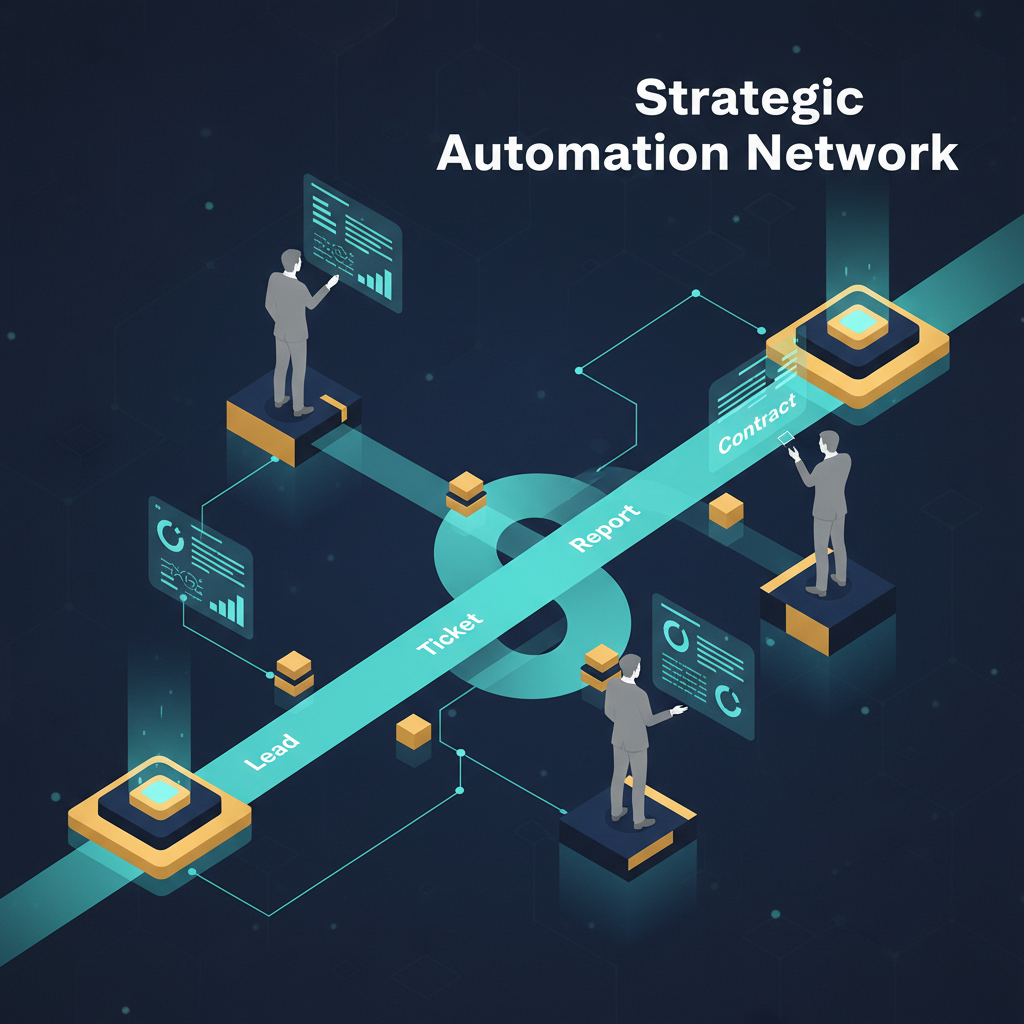
Lead Qualification and Sales Development AI agents can transform the top of the sales funnel by responding to inbound inquiries instantly. These agents can ask qualifying questions, score leads based on predefined parameters, and provide sales teams with a concise summary of the prospect’s needs. This eliminates the delay between a lead’s interest and a company’s response, significantly boosting conversion rates.
Customer Support Triage Customer service is often the fastest area to generate returns. AI agents can classify incoming tickets by intent, detect the urgency of a request, and suggest responses based on historical data. By routing issues to the correct team and escalating high-priority cases automatically, the business maintains high satisfaction levels while reducing the burden on human agents.
Internal Knowledge Management Large organizations often struggle with information silos. AI agents can act as a centralized intelligence layer, aggregating data from across the company to answer employee questions about policies, product specifications, or internal processes. This reduces the time staff spend searching for information and ensures consistency in internal communications.
Operational Reporting and Documentation Generating reports is a notorious time sink. AI tools can pull data from structured sources, highlight significant changes or trends, and draft the initial version of a report for human review. Similarly, in document-heavy industries, AI can extract key fields from contracts or invoices and flag inconsistencies, accelerating the review process and reducing manual errors.
Case Studies and Success Stories
The impact of AI business automation is best illustrated through real-world outcomes. Small businesses, in particular, have seen dramatic shifts in their operational efficiency.
A regional HVAC company recently automated its call answering and scheduling systems. By allowing an AI agent to handle initial bookings, the company improved its booking rates by 65 percent and saved 20 admin hours every week. The project achieved a 595 percent ROI, and the initial investment was paid back in just six days.
In the e-commerce space, one retailer achieved a staggering 1300 percent ROI by automating a suite of tasks including FAQ responses, abandoned cart recovery, and order processing. Their email response time dropped from 18 hours to just two minutes. This shift not only improved the customer experience but also boosted recovered revenue by 8,000 dollars per month.
Larger institutions are seeing similar success at scale. Major banks and service providers, including JPMorgan and Salesforce, have deployed AI agents to handle everything from contract automation to customer support. These enterprises report millions in annual savings and significant improvements in response times. For example, some organizations have seen customer response speeds improve by 82 percent while simultaneously reducing legal costs through automated contract intelligence.
Getting Started with AI Automation
Beginning the journey toward automation does not require a complete overhaul of your existing systems. The most effective approach is iterative.
For SMBs, the path forward involves identifying a single, high-frequency bottleneck and utilizing no-code tools to build a solution. This allows for rapid testing and deployment, often seeing results within a few weeks. The focus should be on simplicity and immediate time savings.
For Enterprises, the approach requires more robust governance. Before deploying agents, these organizations must ensure their data is clean and accessible. Establishing a framework for oversight and security is essential to manage the complexities of large-scale AI integration. Starting with a pilot program in a single department, such as customer service or finance, allows the organization to prove the ROI before expanding the footprint.
The real win of AI is not just doing something flashy, but in quietly shaving hours off your week and freeing up the mental space to think ahead.
Conclusion
AI business automation is no longer a luxury reserved for the world’s largest tech firms. It is a versatile toolset that, when applied strategically, can solve chronic operational inefficiencies for businesses of any size. By focusing on high-frequency, manual tasks with clear patterns, you can ensure your first steps into AI provide a meaningful return.
The goal is not to replace the human element of your business, but to augment it. Start small, measure your results, and choose your automation targets based on the potential for clear, measurable impact. As you build confidence and see the ROI climb, you can expand your AI capabilities, ensuring your organization remains lean, responsive, and ready for what comes next.
References: https://www.klarna.com/ https://www.jpmorganchase.com/ https://www.salesforce.com/ https://www.dbs.com/